
Anúncios
Can a simple change to your fan or ceiling setup make your room feel much cooler without touching the thermostat?
You’ll start by seeing how aerodynamic choices in everyday products — especially the fan you use at home — shape the air you feel and the comfort in your rooms.
Small design details like blade shape and pitch change movement more than you expect. That movement is what creates the real sense of speed, not just the rpm number on a box.
Later you’ll connect those choices to your HVAC and see why the right fan and ceiling setup can reduce hot and cold spots. You’ll learn where energy savings come from: moving air smartly so your system runs less while your comfort rises.
Anúncios
Principales conclusiones
- Small aerodynamic changes in fans and ceiling design affect how air reaches you.
- The feel of speed is driven by air movement, not just fan rpm.
- Matching the right fan to the right room helps reduce HVAC runtime.
- Smart design choices can improve comfort without raising costs.
- You can run simple at-home tests to sense movement and pick a better fan.
Why Aerodynamics Matters to Everyday Comfort, Cooling, and Speed
Directed movement from a well-designed fan changes what you feel in your living space far more than raw motor speed.
You feel comfort when moving air speeds sweat evaporation and reduces heat on your skin. That’s why aerodynamic choices that boost airflow make a room seem cooler without changing the thermostat.
A correctly placed fan helps your hvac system circulate air more evenly. This smooths hot and cold areas so temperature feels consistent as you move through the room.
Anúncios
Small factors — ceiling height, furniture layout, and open doors — change pathways and the effect of fans. Faster, directed flow often feels cooler than higher CFM with poor direction or blocked paths.
- Stand at sitting height and check for steady breeze or stalled spots.
- Move a fan a few feet to see how it evens temperature across an area.
- Match fan size to room area and adjust mounting for consistent coverage.
Even one good fan can lower load on your system during peak cooling, reducing runtime while improving comfort across your home.
Understanding Air Movement: CFM, Air Velocity, and the Wind-Chill Effect
Knowing how much air a fan moves and how fast it reaches you clears up a lot of confusion when you shop.
CFM versus velocity: how much air moves vs. how fast it moves
CFM measures the volume a fan moves in cubic feet per minute. Velocity reports how fast that air travels to you in mph.
Big fans often list high CFM on the box, but that number alone won’t tell you how cool you will feel. Direction and blade design control whether the flow reaches your seating or stalls above it.
What the wind-chill effect means for comfort
The wind-chill effect is simple: faster air speeds evaporation on your skin and feels cooler. So a fan that delivers higher speed at your position will often beat a larger fan that never directs flow toward you.
Airflow efficiency basics: a quick energy check
Do a quick check by dividing CFM by watts at high speed to compare models. Blade pitch, motor design, and mounting height change both volume and velocity.
| Métrica | What it shows | Por qué es importante |
|---|---|---|
| CFM | Volume moved (ft³/min) | Shows capacity but not reach |
| Velocity | Speed at seating height (mph) | Directly links to perceived cooling |
| CFM ÷ Watts | Quick performance ratio | Helps compare similar fans on power use |
- Read both CFM and velocity on the product page, not just the box.
- Consider ceiling height and placement — they change the speed you feel.
- Brands like Hunter focus on blade profiles and motors to boost perceived flow without extra power draw.
Design Factors That Drive Good Airflow: Blades, Size, Distance, and Direction
Good fan design is more than looks — it controls how air moves through your room and how you feel at your seat.
Fan blade shape and pitch matter. Contoured, aerodynamic blades with the right pitch push air smoothly toward you instead of chopping it. That smooth movement feels quieter and more consistent at normal speeds.
Right-sized fans for your space are crucial. A too-small fan will underwhelm in a large room. A too-large fan can overwhelm a small nook. Match blade sweep to room square footage and ceiling height for balanced performance.
Motor pairing, mounting, and reach
Motors tuned to blade profiles give steady torque and quiet operation. Pairing a strong motor with contoured blades delivers the everyday speed and airflow you want without noisy spikes.
Downrod length and mount type change the air column from the ceiling to the floor. Choose a mount based on ceiling height so the fan’s sweep reaches occupants safely and cleanly.
- Pick blades with contour and pitch for smoother flow.
- Match fan size to room area and ceiling height.
- Choose a motor-blade pair that balances quiet operation and steady movement.
Practical Setup Tips to Improve Airflow at Home
Simple seasonal and placement adjustments can transform a ceiling fan into a true room circulator.
Ceiling fan direction by season
Summer: Set your fan to spin counterclockwise to create a downdraft that you can feel at seating level. This boosts perceived cooling without changing thermostat settings.
Winter: Flip the direction to clockwise and run on low. That gentle updraft moves warm air down the walls and back into the occupied space.
Mounting height and downrods
Choose a downrod so blades clear the ceiling and sit roughly 8–9 feet above the floor. That distance keeps blades in cleaner, faster-moving air and reduces wobble.
If you have vaulted ceilings, use a longer downrod to bring the fan into the living zone and preserve proper speed at seating height.
Room layout and obstacles
Keep pathways, vents, and returns clear so your hvac system and ceiling fans can circulate air across the areas you use most.
- Place furniture to open circulation paths.
- Check registers and returns for blockages.
- Use a tissue or ribbon to visualize flow and tweak fan speed and placement.
Maintenance note: Clean blades, coils, and condensate drains on schedule to maintain steady airflow and keep your system working in sync with ceiling fans.
airflow efficiency in HVAC Systems: Thermostats, Fresh Air, and Humidity Control
Balanced delivery of conditioned air keeps your thermostat honest and your home steady. Poor distribution can make a system think a room is warmer or cooler than it is. That leads to short-cycling, extra runtime, and uneven comfort.
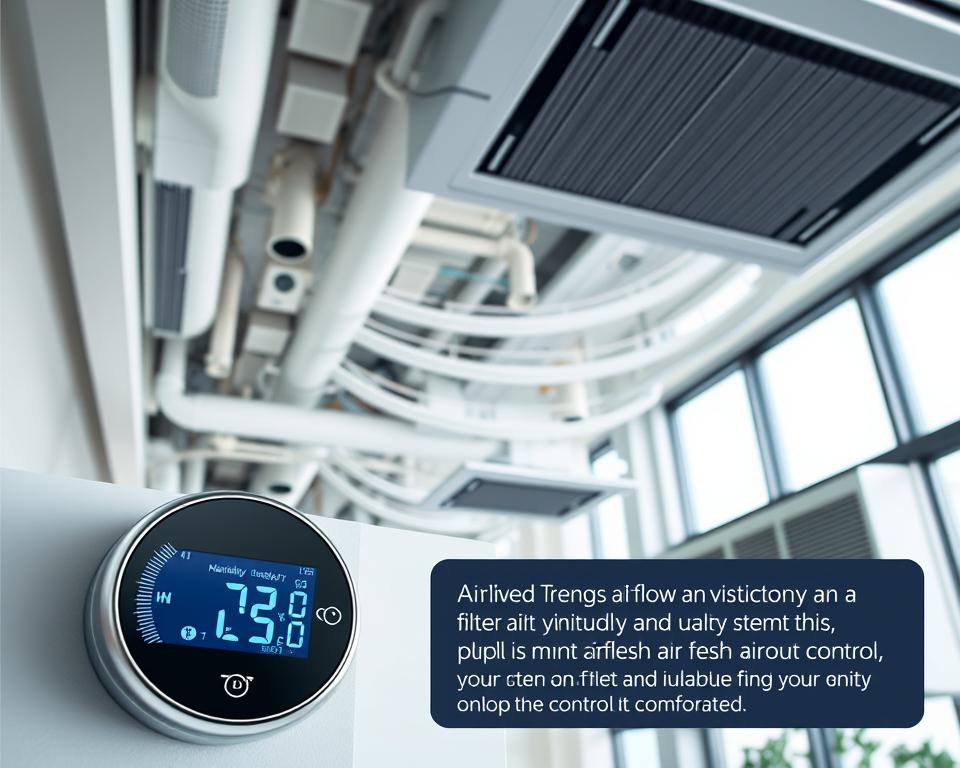
Stable thermostat readings depend on consistent, balanced flow
Make sure supply vents and returns are open and unobstructed.
Technicians often restore proper flow by cleaning vents and checking duct sealing so conditioned air reaches the room instead of leaking into the attic.
Fresh air, pollutant removal, and indoor air quality gains
Bringing in fresh air and filtering recirculated air reduces dust, odors, dander, bacteria, and viruses.
Choose the right filter and change it on schedule to protect your system and keep indoor quality high.
Managing humidity between 35%-55% for comfort and health
Keep relative humidity in the 35%–55% range to lower mold risk and make heat feel less intense in summer.
Seasonal maintenance — cleaning coils, clearing condensate drains, and servicing outdoor equipment — helps maintain steady flow and reduces strain on your hvac.
- You’ll stabilize thermostat readings by ensuring balanced flow through your hvac system.
- You’ll make sure supply vents and returns are open, and you’ll check duct sealing.
- You’ll coordinate ceiling fan use with your system to spread conditioned air after each cycle.
Energy Efficiency, Costs, and Performance: Make Your System Work with Less Energy
Fixing how your home moves air often cuts bills faster than upgrading equipment. You’ll reduce strain on hvac units and avoid some repairs by getting circulation right first.
Routine care matters. Change filters, clean coils, and seal ducts so your system runs smoothly. These steps keep air passing where it should and lower runtime.
Balanced delivery also protects major equipment. When rooms get steady flow, the system stops short-start cycling. That saves components and extends service years.
- You’ll cut costs by fixing blockages and leaks so hvac uses less energy to condition rooms.
- You’ll get the best gains by improving flow first, then tuning schedules and setpoints.
- Fans can be a low-cost way to push air into stagnant zones and make each cycle more effective.
| Acción | Impact on Costs | Typical Payback |
|---|---|---|
| Replace filter on schedule | Reduces runtime and strain | Months |
| Seal ducts and fix leaks | Stops conditioned air loss, lowers bills | 1–2 years |
| Clean coils & drains | Improves system performance | Months |
| Add targeted fans | Boosts room comfort with less energy use | Immediate to months |
Track results. Watch bills and note runtime changes. If some rooms lag, balance registers before assuming a bigger equipment problem.
Advanced Metric Spotlight: Airflow Efficiency Ratio (AER) in Modern Cooling Systems
Knowing how many watts it takes to shift a set volume of air clears up a lot of marketing noise.
AER is the ratio of fan power (watts) to airflow (m³/h) at a given static pressure. Lower W/(m³/h) means less power to move the same volume. That makes AER a handy metric when you compare chilled plants, air handlers, or data center fans.
What AER measures and why lower W/(m³/h) is better
Example 1: 30,000 m³/h at 20 Pa with 3.3 kW fan power gives AER = 0.11 W/(m³/h).
Example 2: 80,000 m³/h at 50 Pa with 28.0 kW fan power gives AER = 0.35 W/(m³/h).
“In free cooling modes, fan power can become the dominant energy draw — optimizing AER saves money and lowers wear.”
| Métrica | Ejemplo | Por qué es importante |
|---|---|---|
| AER (W/m³/h) | 0.11 vs 0.35 | Lower value cuts operating power |
| Static pressure (Pa) | 20 / 50 | Higher pressure raises required watts |
| Application | Data center / AHU | Fan power can dominate energy use |
- Use AER to compare real performance, not just horsepower.
- Favor hvac fans and equipment with lower power at the flow you need.
- Keep filters and coils clean — less resistance improves measured AER.
Maintenance Moves That Keep Air Moving: Filters, Coils, Motors, and Ducts
A few seasonal checks stop small issues from shortening your equipment life and costing you years in repairs.
Start with filters. Pick the right type for your home and stick to a replacement schedule. That protects equipment and preserves airflow so your hvac can breathe.
Filter selection and schedule
Use higher-MERV filters only if your system and fan can handle them. Too-dense media can strain the motor and lower flow.
Coils, drains, and outdoor care
Clean interior coils and clear condensate drains each season. Service outdoor equipment so the whole system moves conditioned air without extra resistance.
- You’ll seal ducts and check registers so the system sends air to rooms, not into attics.
- You’ll verify fan wheels and housings are debris-free and listen for motor strain.
- You’ll factor pet dander, construction dust, and wildfire smoke when setting filter cadence.
- You’ll document airflow readings room by room after maintenance to track gains and plan follow-ups.
“Small maintenance steps pay back quickly — lower repair bills and steadier comfort.”
| Task | Primary Benefit | Typical Frequency |
|---|---|---|
| Filter replacement | Protects equipment, maintains airflow | 1–3 months (home factors dependent) |
| Coil & drain cleaning | Reduces resistance, improves air quality | Annually or seasonally |
| Duct sealing & register check | Delivers conditioned air to rooms | Every 1–3 years |
Buyer’s Quick Guide: Matching Fans and HVAC to Your Space and Use
Picking the right fan starts with matching its sweep and motor to how you use the room.
Look beyond the box. Scan spec sheets for motor power, blade design, and realistic speed settings. Larger ceiling fans can list higher CFM, but they only work if the fan size fits the room and seating layout.
Ceiling fan features to prioritize: motor performance, blade design, speed
- Match fan diameter to room area so flow reaches where people sit.
- Prefer blades with good pitch and contour; number of blades is mostly aesthetic.
- Estimate airflow from CFM per watt at high speed to find models that use less energy.
- Pick mounting hardware or downrods by ceiling height so blades sit 8–9 feet above the floor.
- Check return placement and door undercuts to help your system move air after cycles.
- Balance noise, controls, and long-term comfort when choosing equipment.
| Característica | What to check | Por qué es importante |
|---|---|---|
| Motor | Torque and warranty | Delivers steady speed at load |
| Blade design | Pitch and contour | Directs flow to seating |
| CFM per watt | High-speed rating | Shows real airflow and energy efficiency |
| Mount type | Fixed, angled, downrod | Positions blades for optimal ceiling performance |
Conclusión
When you tune how air moves in each room, you can cut costs and raise comfort without swapping out major equipment. You’ll leave with clear ways to improve comfort across your home: smart fan placement, seasonal ceiling direction, and uncluttered pathways that keep air moving where you sit.
Start simple. Use blade design, proper sizing, and the right mount to turn a fan into a daily comfort tool. Keep up with maintenance so vents, filters, and coils stay clean and steady.
You’ll also learn easy metrics—CFM per watt and AER—to compare upgrades. Apply these ideas room by room and you may also see lower bills, fewer hot spots, and smoother hvac system cycles.

 Spanish
  English