
Anúncios
Can a smarter thermal strategy unlock more range, faster charging, and longer life for your electric vehicle?
Usted rely on compact systems that move energy cleanly and reliably. In EVs, controlling temperature and directing heat transfer decides whether a pack performs or underdelivers. Small design choices ripple into range, charging speed, and component life.
Modern EV platforms borrow proven exchanger ideas—plate, finned, and shell concepts—and adapt them into radiators, battery cold plates, and chillers. Right-sizing parts and matching flow to load avoids wasted energy and protects performance.
Material choices, uniform flow, and smart controls keep hotspots, fouling, and pressure loss in check. When you combine sensors, variable flow, and recovery loops, the result is a cohesive thermal architecture that supports driving demands and real-world applications.
Anúncios
Principales conclusiones
- You’ll see how targeted heat control shapes EV range and reliability.
- Industrial exchanger principles translate to compact EV designs.
- Proper sizing and flow balance prevent energy waste and damage.
- Materials and surface geometry boost transfer in tight packages.
- Active control and recovery strategies improve efficiency in varied conditions.
Understand Your EV Thermal System: Components, Loads, and Heat Paths
Start by mapping every component that generates thermal loads in your EV and how each connects to exchange surfaces.
List major sources: battery pack (cell and pack resistive losses), inverter and power electronics, traction motors, on-board charger and DC/DC converters, plus cabin HVAC loads.
Quantify representative loads for driving, charging, and varying ambient conditions. Use those numbers to balance energy in versus energy out for your system.
Anúncios
Identify sinks and paths
Mark radiators, plate chillers, cold plates, condensers/evaporators, and ambient airflow as primary sinks. Then trace each source to its sink—liquid loops, refrigerant circuits, cold plates, or air-side exchangers.
“Optimal fluid distribution across exchange surfaces avoids hotspots and preserves performance.”
Practical checks
- Review packaging and airflow limits in the front module and underbody for pressure-drop constraints.
- Run CFD early to find maldistribution at manifolds and visualize temperature gradients at critical nodes.
- Specify high-conductivity materials (copper, aluminum, stainless) and add insulation where retention or isolation is needed.
- Instrument cell groups, inverter substrates, and chiller outlets to capture validating data and document subsystem interfaces.
| Fuente | Typical Load (W) | Primary Path | Common Sink |
|---|---|---|---|
| Battery pack | 500–2000 | Liquid cold plates | Plate chiller / radiator |
| Inverter & power electronics | 100–800 | Liquid loop / conduction | Cold plate / radiator |
| Traction motors | 200–1500 | Liquid jackets / air ducts | Radiator / ambient airflow |
| Cabin HVAC | 500–3000 | Refrigerant circuit | Condenser / ambient |
How Heat Exchangers Drive EV Efficiency
Industry-tested exchanger forms translate well when you need compact, high-performance EV cooling hardware.
Translate proven types into EV practice: shell-and-tube ideas give robust performance where durability matters. Plate exchangers fit tight battery and inverter spaces. Finned tubes suit air-side rejection when airflow rules.
Match capacity, flow, and operating temperatures
Match load to exchanger capacity and flow rates to avoid wasted energy or throttled performance. Oversizing wastes energy; undersizing hurts efficiency and longevity.
Use counterflow layouts where you can to improve temperature approach. Pick copper, aluminum, or stainless for high thermal conductivity. Add insulation to keep transferred energy where you want it.
“Uniform flow distribution prevents hotspots and keeps system performance repeatable.”
- Validate pump curves and coolant properties so flow targets hold across conditions.
- Use CFD to fix maldistribution at manifolds and plate channels.
- Tie exchanger outputs to control strategies—fans, pumps, and valves—to keep efficiency steady as load changes.
| Exchanger | Best application | Key benefit |
|---|---|---|
| Plate chiller | Battery & inverter loops | High effectiveness in compact packages |
| Finned radiator | Air-side rejection | Increased surface area for continuous loads |
| Shell-and-tube | Robust, duty-cycle systems | Durability across varied conditions |
Set Clear Performance Targets and Constraints
Turn goals into measurable parameters before you finalize any hardware or software choices.
Begin with numeric limits: define cell, inverter, and motor temperature limits and acceptable delta-T windows for each operating condition. Set allowable pressure drops across cold plates, radiators, and hoses so pumps run in efficient bands.
Establish power and efficiency targets for peak and continuous use. Include charging and cold-weather scenarios so your design reflects real-world conditions.
Prioritize trade-offs
Balance packaging, noise, fan and pump speeds, and cost. Use data-driven limits for temperature rise per kilowatt to guard against spikes and transients.
Control and verification
Specify control response times and stability for pumps, fans, and valves. Require CFD and thermal analysis sign-off to confirm uniform flow and avoid hotspots that reduce performance.
- Cap component and fluid temperatures to protect durability.
- Build margins for fouling and degradation over life.
- Document verification points and allowable variance for testability.
| Target | Example Value | Propósito |
|---|---|---|
| Cell max temperature | 45°C | Limit aging and retain performance |
| Delta-T across cold plate | 3–7°C | Maintain uniform temperatures |
| Allowable pressure drop | Keep pump power within efficiency band | |
| Control response time | Stabilize temperatures during transients |
“Clear targets make trade-offs measurable and keep system decisions aligned with real-world performance.”
Heat Optimization: Your Step-by-Step Approach
Start with clear measurements so your next changes deliver real gains.
Assess current performance: capture baseline data across representative cycles — urban, highway, grade, and charging. Build thermal maps of cells, manifolds, and exchangers to visualize transfer paths and locate hotspots.
Choose the right methods
Decide if you’ll begin with small design tweaks, control updates, or a full system re-architecture. Use CFD and 1D analysis to model flow and temperature fields before changing hardware.
Plan validation and tests
Set up A/B tests on instrumented routes to isolate the impact of each change. Implement telemetry logging for temperatures, flow, pressure drop, and power so you can correlate actions with results.
- Prioritize fixes that improve both efficiency and peak capability, like better distribution and counterflow layouts.
- Verify that control updates keep temperatures stable during fast transients without oscillation.
- Schedule follow-up tests across seasons to confirm gains hold in varied ambient conditions.
“Uniform flow and optimal velocities prevent fouling and protect long-term efficiency.”
Document your processes and lessons learned. That record shortens iteration time and helps you repeat successes when you scale the system.
Size for Reality: Matching Heat Load, Flow, and Heat Transfer Area
Sizing exchange surfaces starts with realistic peak and continuous loads rather than theoretical maxima.
You should calculate peak and steady losses for the battery, inverter, motors, and OBC. Use those numbers to anchor required heat transfer area and target flow rates.
Size cold plates and exchangers so they meet the load at your chosen temperature approach without large pressure drop. Avoid oversizing that raises pump and fan energy. Avoid undersizing that forces derating or thermal throttling.
A practical checklist
- Include fouling and aging margins when you set sizing parameters.
- Verify velocities to prevent sedimentation at low flow and erosion at high flow.
- Pick high-conductivity materials or enhanced surfaces where packaging is tight.
- Balance radiator frontal area, fin density, fan curves, and vehicle drag.
- Use CFD and 1D models to iterate manifold and core dimensions before prototyping.
“Match realistic loads to flow and surface area to preserve efficiency and long-term performance.”
| Item | Sizing Focus | Design Action |
|---|---|---|
| Battery pack | Peak & continuous losses | Cold plate area per cell; include fouling factor |
| Inverter & power electronics | Local hotspots and pressure drop | Optimize channel geometry and manifold balance |
| Radiator / air-side | Frontal area vs. fan power | Trade fin density with fan curve and drag |
Design Fluid Flow for Uniform Distribution and Stable Temperatures
Map fluid routes early to prevent channel starvation and maintain steady component temperatures.
Balance manifolds so each channel in a plate chiller or cold plate sees similar flow and temperature. Uneven distribution causes localized hotspots and lowers overall efficiency.
Right-size velocities to keep flows in a regime that boosts heat transfer but avoids erosion and excessive pressure drop. Low flow invites fouling; excessive flow shortens exchanger life.
Use CFD and targeted analysis
Run CFD to reveal dead zones, recirculation, or jetting that create uneven temperatures or vibration issues. Use that analysis to tune channel geometry, baffles, and inlet placement.
Validate in hardware and loop control
Coordinate pump curves and valve settings so actual operating points meet your flow and temperature parameters. Instrument branches with differential pressure and temperature sensors to confirm modeled results on-vehicle.
“Uniform distribution protects components and preserves system results over life.”
- Balance manifolds to avoid starving downstream channels.
- Adjust channel geometry and baffles to remove maldistribution.
- Consider counterflow layouts and high-conductivity materials with insulation where needed.
- Reassess after each change to verify improved efficiency and component temperatures.
Select High-Conductivity Materials and Smarter Geometries
Pick metals and surface forms that let your cooling hardware move energy with low resistance and long life.
Use the right alloy where conductivity and durability matter. Choose copper or aluminum for cold plates and radiators to reduce thermal resistance and improve heat transfer. Use stainless alloys when corrosion resistance or mechanical strength is required.
Material choices that work
Balance conductivity with corrosion risk and cost. Validate compatibility with your coolant and avoid galvanic pairs that cause corrosion.
Surface and geometry tactics
Add enhanced surfaces—micro-fins, dimpled plates, or textured channels—to boost turbulence and heat transfer in tight packages.
“Enhanced surfaces and targeted fins keep temperatures uniform while limiting added mass.”
- Apply fins on the air side where airflow limits transfer.
- Use coatings that resist deposits to preserve long-term efficiency.
- Prototype and run CFD to confirm performance gains without excessive pressure drop.
| Material | Key property | Mejor uso |
|---|---|---|
| Copper | High conductivity | Cold plates, tight thermal paths |
| Aluminum | Good conductivity, light | Radiators, mass-sensitive parts |
| Stainless alloy | Corrosion resistance | Structural exchangers, harsh environments |
Choose Cooling and Heating Media with the Right Properties
Your fluid choices shape how well the system moves energy and keeps components within safe limits.
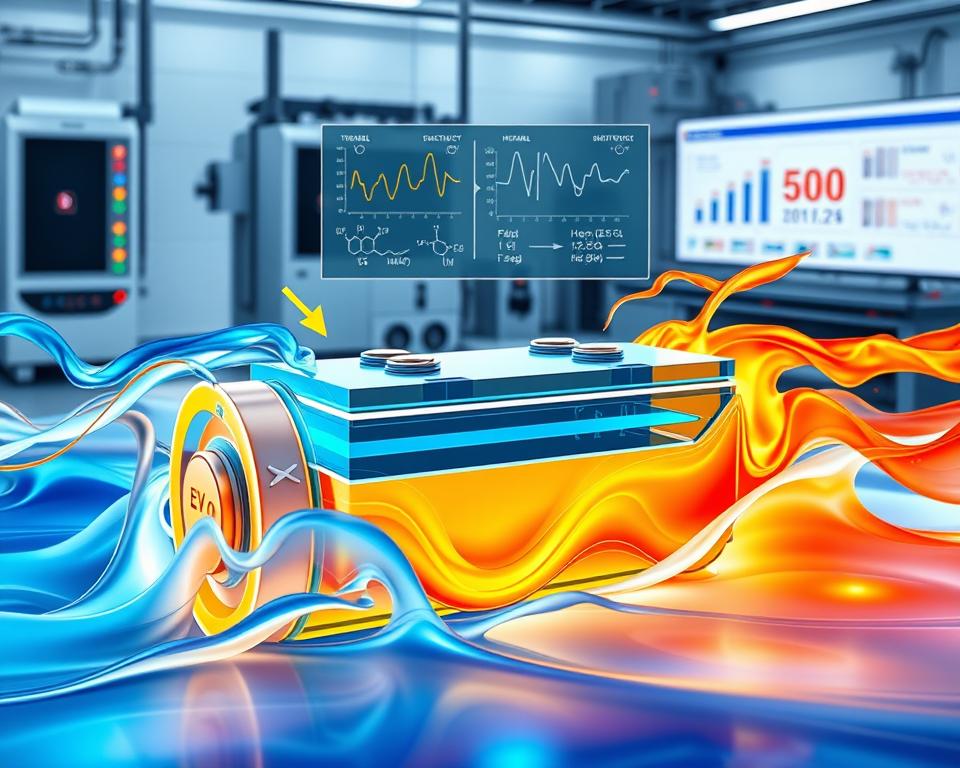
Pick fluids for conductivity, viscosity, stability, and compatibility
Select coolant formulations that offer high thermal conductivity and stable viscosity across the full operating range. Confirm material compatibility with metals and elastomers to prevent corrosion and deposits.
Consider dielectric fluids when you need direct-contact cooling for electronics. Also match pump and valve specs to fluid viscosity and NPSH so you avoid cavitation and maintain flow.
Plan fluid analysis and replacement intervals
Establish a fluid analysis program to track viscosity, thermal stability, contamination, and additive levels. Use those results to set replacement intervals per supplier guidance and real-world data.
“Regular checks catch degradation before efficiency drops and protect heat transfer surfaces.”
- Validate cold-start viscosity so components get flow in winter.
- Coordinate lubricant selection where pumps or bearings share the loop.
- Install filtration and air-purge methods to protect exchangers and prolong life.
| Item | Key property | Acción |
|---|---|---|
| Coolant | High conductivity, stable viscosity | Periodic analysis; replace per results |
| Dielectric fluid | Non-conductive, stable across temps | Use for direct-contact electronics; monitor contamination |
| Lubricant | High thermal stability, low friction | Match to mechanical parts; check compatibility with coolant |
Control Strategies: Precise Temperature and Dynamic Flow Management
You’ll get the best range and durability when sensing and controllers act together to match cooling to demand.
Place sensors at battery modules, inverter substrates, motor stators, and exchanger inlets and outlets. Those points give you real-time temperature data so automated controllers can act fast.
Integrate sensors and automated controllers
Use controllers to modulate pumps, fans, and valves and keep components in tight bands. Tune control loops for fast response without overshoot to avoid stress on cells and electronics.
Variable flow and temperature strategies
Adjusting flow rates of hot and cold fluids is fundamental to getting the desired differentials. Variable flow saves energy and reduces component wear by matching capacity to real-time generation.
- Integrate ambient sensors and vehicle state to anticipate loads during climbs or fast charging.
- Coordinate battery preconditioning with cabin HVAC to share capacity while protecting cells.
- Log controller actions and temperatures to refine maps and run regular analysis.
- Simulate failures—sensor loss or stuck valve—and define safe fallback operation.
“Proper sizing and real-time control deliver stability, lower energy use, and improved overall efficiency.”
Insulation Tactics that Reduce Losses and Protect Performance
A smart layer of insulation preserves targeted temperature and trims unwanted energy loss. Use simple materials to form a protective envelope that keeps your components within intended limits.
Apply external wraps and internal barriers to keep heat where it belongs
External jackets on radiators, cold plates, and hot lines minimize loss to ambient air. Internal barriers stabilize module temperatures under varied conditions and reduce cycling that shortens life.
- Wrap radiators and cold plates where space allows to cut undesired heat gain or loss.
- Install internal partitions to hold steady temperatures for sensitive components.
- Pick low-conductivity materials—fiberglass, mineral wool, closed-cell foam—based on durability and underhood compatibility.
- Balance thickness with packaging, service access, and cost to preserve efficiency.
- Target areas prone to soak or splash to stabilize operation in real-world applications.
- Verify insulation does not block airflow, drainage, or maintenance access.
- Measure surface temperatures before and after installation to quantify energy savings and heat transfer improvements.
- Apply insulation selectively in winter to speed battery warm-up and improve cabin efficiency.
“Proper insulation reduces fluctuations, improves safety, and extends component life.”
Prevent Fouling, Aging, and Performance Drift
Catching early fouling prevents gradual performance drift and costly downtime.
Plan routine checks so deposits never get a foothold. Scheduled inspections reveal buildup before pressure drop and reduced efficiency force derates.
Adopt a mix of cleaning methods that match the deposit type: chemical descaling, mechanical brushing, and targeted water-jet flushing. Record the chosen methods and the before/after metrics so your team learns what works.
Design and flow tactics to resist deposits
Use turbulators or tweak channel geometry to break laminar layers and reduce settling. Add enhanced surfaces or low-adhesion coatings to discourage attachment and make cleaning easier.
Practical monitoring and maintenance steps
- Set inspection intervals tied to vehicle hours and duty cycle to spot fouling early.
- Keep velocities in a safe window to avoid sedimentation and prevent erosion of exchanger surfaces.
- Track differential pressure and outlet temperatures as early warning signals of drift.
- Send fluid samples for analysis to find contaminants that speed deposits or corrosion.
- Validate post-cleaning heat transfer and performance against baseline to confirm recovery.
- Document cleaning effectiveness and update schedules to balance uptime and cost.
- Plan access points so you can inspect and clean without full disassembly.
“Catching early fouling prevents gradual performance drift and costly downtime.”
Recover and Reuse Heat to Boost Overall System Efficiency
You can turn wasted thermal output into useful energy that speeds warm-up and lowers battery draw. Integrating recovery loops and dedicated exchangers helps preheat fluids and supports cabin heating during cold starts. This reduces the electrical load on your pack and improves overall efficiency.
Preheat fluids and leverage waste for cabin comfort
Route inverter and motor waste through plate exchangers to preheat battery coolant or feed the HVAC refrigerant loop. Plate units give compact, high-effectiveness heat transfer between circuits without large mass penalties.
- Prioritize recovery during cold starts so battery warm-up is faster and charging losses drop.
- Coordinate control logic so recovered energy never pushes component temps past safe limits.
- Consider thermal buffering when generation and demand are mismatched to smooth operation.
- Insulate recovered-fluid paths to keep gains where they matter and protect range.
“Validate recovery across common drive cycles and cold ambients and measure net gains, including pump and fan power penalties.”
Thermodynamic Insights: Optimize for Real-World Power and Time
Understanding finite-time limits helps you design systems that deliver usable performance, not theoretical bests.
Fixing the hot-side input energy (Q0) in a low-dissipation model shows why maximum power arrives at a longer cycle than the minimal feasible time. The hot isotherm scales as Qh = ThΔS − σh/th and the cold as Qc = TcΔS + σc/tc. Solving with Qh = Q0 gives th* = σh/(ThΔS − Q0) and an optimized tc* that maximizes power.
That solution means total optimal time t* = th* + tc* exceeds the lower bound set by the irreversibilities. In practice, small increases in Q0 shorten th* and lengthen tc*, leaving total time roughly constant to first order while raising work and power.
Balance cycle time, power output, and irreversibilities
Use finite-time models to set realistic targets. The temperature difference between reservoirs affects attainable work far more than modest input changes. Translate σh and σc into design levers—surface area, flow balance, and control precision—to reduce losses.
“Model-driven constraints keep you from chasing unattainable maxima that fail under real driving and charging windows.”
- Balance cycle and stage times to maximize practical power.
- Prefer larger effective temperature differences (counterflow, lower sink temps) for bigger gains.
- Validate models with on-road analysis and tune control parameters to account for irreversibilities.
Data-Driven Tuning: Models, Parameters, and Iteration
Let measured temperatures and flows feed compact models so your vehicle controllers act on reality, not ideal cases. Build a control-oriented approach that links sensors, reduced-order predictors, and actuator commands. That loop keeps your thermal targets steady and helps you detect drift before it cuts range or longevity.
Build control-oriented models and calibrate with on-road data
Empieza poco a poco: create reduced-order models that run in real time on vehicle controllers. Calibrate those models using logged data from instrumented routes—temperatures, flows, and pressures across diverse conditions.
Track KPIs: temperature spread, efficiency, pressure drop, and response time
- Monitor temperature spread across cells and between loop inlet/outlet to spot distribution issues.
- Record efficiency, pressure drop, and response time so you meet performance and durability targets.
- Use analysis to link control changes to measurable improvements in transfer effectiveness and system work.
- Iterate: update pump/fan maps, valve strategies, and setpoints based on results and repeatable routes.
- Archive datasets and share dashboards so validation and engineering teams shorten tuning cycles.
“Confirm predictions match measured results within acceptable tolerance before wide deployment.”
Implementation Roadmap: From Prototype to Production
Move from lab benches to piloted fleets in clear steps that prove the system under real drives.
Usted begin with rapid prototypes to de-risk design and control concepts before tooling. Pilot upgrades on instrumented vehicles validate behavior under variable loads. That field data improves processes and reduces surprises in production.
Use step-by-step methods to roll out changes. Isolate variables so each change shows clear results. Lock in design controls and verification checklists to make manufacturing repeatable and reliable.
Pilot, validate, and scale
- Instrument routes for temperature, flow, pressure, and power to prove operating envelopes.
- Scale supplier processes for materials, coatings, and enhanced surfaces that hit performance targets.
- Define operating envelopes and calibrate controls for cold starts and fast charging.
| Fase | Key deliverable | Validation metric | Typical time |
|---|---|---|---|
| Prototype | Rapid hardware and control iterations | CFD, bench flow balance | 3–6 months |
| Piloto | Instrumented fleet tests | On-road temp spread, pressure drop | 6–12 months |
| Pre-production | Locked design controls & quality gates | Supplier audits, assembly yield | 3–6 months |
| Production | Scaled manufacturing and service training | Field reliability, maintenance intervals | Ongoing |
“Uniform flow distribution and early CFD reduce hotspots, while scheduled maintenance preserves long-term performance.”
Conclusión
The real win comes when material, flow, and control decisions operate as one tuned system.
Usted now have a clear path: size exchangers to real loads, balance flow for uniform temperature, and pick materials that cut losses while keeping costs down. Use insulation and fouling prevention to hold gains over the long term.
Apply variable flow and temperature strategies to match demand and recover waste heat for faster warm-up and better winter range. Combine data-driven models with staged testing to move from prototype to production with confidence.
fuerte, validate on-road, keep tuning, and your thermal management will raise efficiency, protect performance, and reduce total energy work across real-world applications.

 Spanish
  English