
Anúncios
You want your car to feel alert and predictable. This article gives a clear roadmap from a simple definition of responsiveness to quick checks you can run at home. You’ll learn which maintenance and upgrades make the biggest gains, from oil and air-filter care to intake, exhaust, and ECU tweaks.
Hidden factors like road roughness, payload, speed, and environmental exposure shape how your vehicle reacts. Professional test methods compress years of wear into hours, helping you match real-world loads without over-testing.
Modern drive-by-wire mapping can soften throttle feel, but plug-and-play enhancers offer a non-invasive way to improve perceived response. Small service actions — tire pressure, alignment, removing excess weight, and clean aero surfaces — also add measurable power and efficiency.
Read on for easy, repeatable checks and step-by-step advice so you spend time and money only where it matters. The tips are practical, safe, and ready for drivers in the United States.
Understand What “Responsive” Really Means for your vehicle
How quickly your inputs translate into motion comes down to the wiring, hydraulics, and software that sit between your hand, foot, and the road.
Anúncios
You’ll break responsiveness into three clear paths: throttle, brake, and steering. Each path passes signals through electronic and mechanical systems that set the position and rate of motion you feel.
Data from NATC shows road roughness and speed change input frequencies dramatically (for example, 1–100 ft wavelengths at 68 mph create 1–100 Hz inputs). Matching test energy to your real roads prevents over-testing and false fixes.
- You’ll map how pedal and wheel inputs flow through sensors, actuators, and tuning so you can describe issues clearly.
- You’ll set realistic daily goals that balance safety, control, and speed rather than chasing raw numbers.
- You’ll learn why throttle response is only part of the picture — brake bite and steering precision finish the job.
Auction Direct USA highlights basic maintenance and careful ECU tweaks as high-return steps to improve throttle response and overall handling. Use this framework to compare cars by consistent inputs and measurable outcomes.
Anúncios
Diagnose Your Current Responsiveness Before You Change Anything
Start by measuring how your car actually behaves today before changing parts or settings. A simple baseline tells you what to fix first and avoids wasted upgrades.
Spot early signs
Watch for pedal lag, soft brake bite, vague steering, or easy tire spin from a stop. These clues show the system isn’t translating inputs cleanly.
Quick driveway checks
Confirm tire pressure on all four corners and feel the pedal for stickiness or uneven travel. Note brake bite on the first stop.
Do a simple battery check: clean terminals and measure resting voltage. Low voltage can skew sensors and lower reliability.
Road-test routine
Pick a short, repeatable route and keep your inputs consistent. Time simple accelerations and stops, and log ambient conditions and tire pressure as parameters.
- Write what you feel in the pedal and steering alongside your times to capture both numbers and driving experience.
- Repeat tests at the same time of day to limit temperature-driven variation.
Use this baseline to prioritize changes. Auction Direct USA and NATC recommend tire pressure, alignment, and controlled parameters to produce clear, comparable results.
How road roughness, vehicle speed, and load shape your response
The same stretch of asphalt sends very different signals to your chassis depending on how fast you go. Match speed to surface so tests reflect the real conditions you drive every day.
Why speed and surface work together
NATC data links roughness and speed to input frequency bands (for example, 1–100 ft wavelengths at 68 mph ≈ 1–100 Hz, and at 27 mph ≈ 0.4–40 Hz). You’ll pick test speeds that hit the same frequency range your suspension sees on commute roads.
Payload and weight distribution
Extra weight or bad load balance makes steering slower to settle and braking distances longer. Keep fuel, cargo, and passenger load similar between tests so your measurements stay valid.
Environmental loads
Heat, humidity, rain, and corrosion change bushings, tires, and brake parts over time. Add repeated stops or a known pothole to your loop to watch how consistency shifts as components heat up.
- Match test speeds to common surfaces you use.
- Control tire pressure, payload, and driving style as parameters.
- Follow NATC testing methods via NATC testing methods to avoid over-testing and keep comparisons fair.
Maintenance first: the fastest wins for sharper handling and control
Simple maintenance often returns the largest improvements to handling and control with the least cost or downtime. Start here and you’ll notice real changes at the wheel before spending on parts.
Oil, air filter, and tune-ups: keep the engine and systems responsive
Regular oil changes and fresh air filters keep the engine breathing clean and efficient. Auction Direct USA recommends scheduled tune-ups to prevent lag and save fuel.
Keep service intervals so small faults don’t cascade into bigger issues. Document dates and mileage so you can tie gains to actual maintenance.
Tire maintenance: pressure, alignment, and choosing the right tire for your needs
Set tire pressure to the door‑jamb spec and check alignment regularly. Proper contact patches give sharper steering, better braking, and steadier handling.
- Pick tires tuned to your roads and weather to improve real-world vehicle performance.
- Inspect brake pads and fluid to restore initial bite before chasing complex fixes.
- Remove excess cargo and roof gear to drop weight and drag for livelier control.
Air in, exhaust out, and smart ECU updates
Improving how your engine breathes and how the computer manages that air is one of the quickest ways to sharpen drivability. Start with low-restriction parts, then match a careful tune so gains feel natural every day.
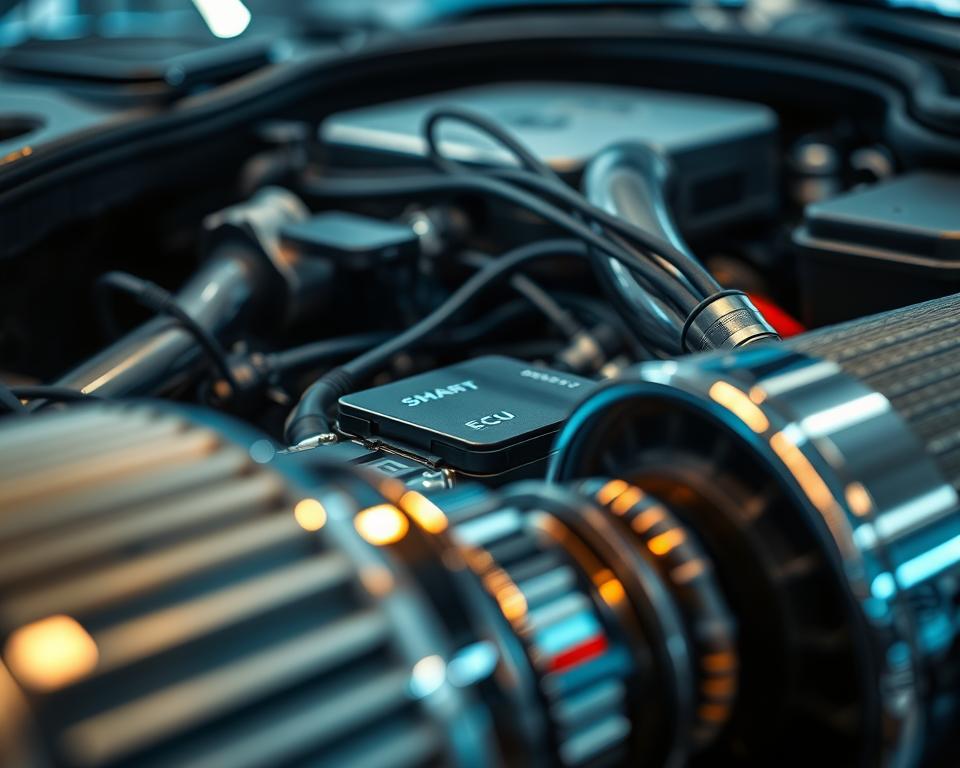
Improve breathing: quality air intake and exhaust fundamentals
A well-designed air intake reduces restriction and steadies airflow. Auction Direct USA notes that a high-quality aftermarket intake can boost airflow, horsepower, and fuel efficiency.
A tuned exhaust helps scavenging and gas evacuation. Balance backpressure for your setup and respect local noise rules so the upgrade stays street-legal.
ECU optimization: when recalibration can aid throttle response and drivability
Factory maps often trade snap for smoothness. A recalibration can restore a livelier throttle feel while focusing on drivability rather than chasing peak numbers.
Bully Dog recommends disconnecting the battery during some installs so the ECU relearns the correct pedal position on reconnection. Plug-and-play controllers can change the throttle rate without adding horsepower.
Key steps to plan upgrades
- Evaluate an intake that reduces restriction and stabilizes air flow for cleaner engine reaction.
- Choose an exhaust that improves scavenging and sound while obeying local limits.
- Consider ECU recalibration to improve throttle feel and consistent drivability.
- Install intake, exhaust, and calibration together so air, fuel, and spark strategies match.
- Follow safe installs (battery disconnect when appropriate) and use your test loop to measure before-and-after gains.
Measure changes on your regular route so any perceived gains tie to data, not just how the car seems on a short drive.
Throttle response you can feel: how drive‑by‑wire and pedal controllers work
In many cars today, the pedal no longer links directly to the throttle, so feel depends on software as much as hardware. That digital gap lets manufacturers tune how your foot maps to engine action for emissions, comfort, and safety.
Drive-by-wire explained: why factory maps can delay throttle
Drive‑by‑wire systems replace cables with sensors and software. Since the 1980s, maps have been used to soften initial throttle for emissions and smoothness, which can create noticeable lag during merging or passing.
Installing a throttle enhancer: plug-and-play tips
Plug-and-play controllers like Bully Dog’s Thruster use OEM connectors at the pedal. Install is simple: connect, disconnect the battery, then let the ECU relearn pedal position on restart.
Safety benefits and dialing in sensitivity
Faster, tuned pedal mapping improves confidence when merging, towing, or passing without adding horsepower. Mount the control box under the dash, secure the knob with cable ties, and keep settings conservative at first to avoid wheelspin.
- Test settings on your usual route and document your preferred range.
- Remember this part changes pedal mapping, not engine internals.
Chassis upgrades that amplify vehicle response performance
Small changes to brakes and suspension often create the biggest gains you’ll actually feel on commute roads.
Start with consistent braking. Choose pads and rotors that resist fade, then validate consistency with a series of repeated stops that mimic your commute patterns. NATC highlights cumulative braking events as a controlled test element; use this to check how parts heat and settle over runs.
Brake consistency and hardware
Consider stainless lines and fresh fluid to improve pedal feel and cut sponginess during back‑to‑back stops. Keep an eye on rotor condition and pad compound so heat buildup doesn’t erode control.
Suspension, tires, and chassis balance
Update worn bushings and dampers to reduce roll and pitch. That makes steering feel more immediate and predictable.
- Match springs and dampers to your roads and speeds so gains show up where you drive most.
- Pair tires to climate and route with correct load rating and compound to turn steering inputs into reliable grip.
- Keep upgrades balanced front to rear to avoid new handling quirks.
Make incremental changes and re‑test. Auction Direct USA recommends brake and suspension upgrades to lift both safety and handling. After each step, run the same loop and log results so every change adds control without hurting daily comfort.
Read more on practical setup tips for suspension and driver tuning at suspension and driver tuning.
Electrical, fuel, and reliability factors that slow response
Clean power and steady fuel are the unseen foundations of a dependable driving experience. Ignoring them lets small faults masquerade as bigger issues and steals confidence on every run.
Battery health and terminal corrosion: clean power for consistent inputs
Check the battery state of charge and inspect terminals for corrosion. A low charge or crusty posts cause fluctuating voltage that confuses sensors and control modules.
- You’ll inspect the battery for charge and clean any terminal corrosion to restore stable voltage for sensors and control modules.
- Look for loose clamps, damaged cables, or poor grounds that create intermittent faults.
Fuel quality and delivery: avoiding knock, hesitation, and lost range
Use reputable stations and the correct octane to reduce knock and hesitation. Contaminated or low-quality fuel can cut range and mimic throttle lag.
- Consider fuel filters and pumps as part of the system; delivery issues can mimic a lagging throttle.
- Factor climate and storage: moisture and corrosion speed electrical and fuel-system wear.
“NATC blends environmental loads like corrosion with dynamic testing to mirror real service life.”
Schedule service before issues become no-starts or mid-pass stumbles. After fixes, recheck parameters on your test loop so you confirm real gains in daily reliability and driving experience.
Validate your changes: a simple, safe test plan you can repeat
Confirming gains starts with a simple, repeatable plan that mirrors your daily route. Keep it short, safe, and focused on the conditions you actually drive so results matter to you.
Match the test to your use
Design a route that mirrors commute roads and common errands. Don’t over-test on tracks or ultra‑rough loops that your vehicles never see.
Control parameters
Fix tire pressure, fuel level, gear selection, and speed before each run. Keep driver input cadence steady so times and feel are comparable.
Measure, adjust, and log
Pick safe metrics: 30–50 mph acceleration times, 40–0 mph stops, and a steady hill climb. Repeat three times to watch heat effects.
- Keep payload and passenger count the same.
- Note throttle position, pedal feel, and ambient conditions.
- Change one item at a time so results are clear.
- Repeat monthly or seasonally to track long‑term range and rate shifts.
“Match test input energy to real user conditions and avoid over‑testing beyond your roughest field terrain.” — NATC
Use this plan to prove Auction Direct USA maintenance and ECU changes deliver the gains you expect, then log results in a simple spreadsheet for confidence over time.
Conclusion
Make small, repeated steps and you’ll see big gains in everyday control. Start with routine service and simple checks, then add intake, exhaust, or ECU tweaks only when your tests show real value. Keep tests matched to your roads and loads so results stay meaningful.
You now know how systems like tires, brakes, suspension, intake/exhaust, and calibration shape vehicles and their handling. Aim for balanced upgrades that improve vehicle performance without compromising comfort.
Protect reliability by tracking maintenance and environmental factors. Use a short, repeatable test plan to validate each change and log results over time.
Stay practical: match fixes to your needs, keep changes measurable, and give yourself access to clear data so you can tune with confidence as conditions evolve.